
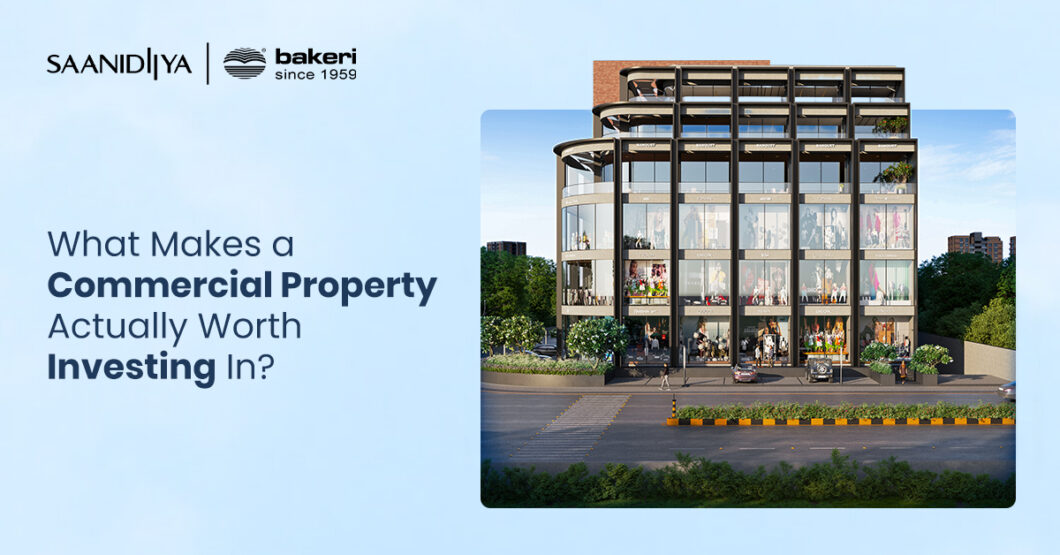
Most people buying commercial property in Ahmedabad start with two questions. Which area? What’s the price?
Those aren’t wrong questions. They’re just not enough. Area and price tell you where you stand in the market. They don’t tell you whether the property will actually perform once you own it. Two units on the same road, similar in size and price, can produce completely different outcomes over five years. The difference usually comes down to things most investors never get around to checking.
Why Commercial Over Residential?
It’s worth being honest about this upfront.
Residential housing in Ahmedabad yields 2- 4 per cent annually. Commercial, when you pick right, delivers 5-9 per cent. Leases run for three to ten years rather than eleven months. Maintenance often falls on the tenant, not you. And appreciation in commercial corridors tends to track economic activity rather than just housing demand. It’s a different asset class. The way you evaluate it should be different too.
| Project | Location | Demand Type |
|---|---|---|
| Sakar One | Hebatpur, Shilaj Road | Office and retail, business-driven |
| Sakar Two | Ambli-Bopal | Retail, residential catchment |
| Sakar Three | Navrangpura | Mixed use, established ecosystem |
So before getting into what actually makes a commercial property perform, it helps to understand what you’re really evaluating.
A commercial property is worth investing in when it generates consistent cash flow and has room for capital appreciation over time. That comes down to two things: getting reliable tenants in, and keeping your operating risk low once they’re there.
Everything else follows from that.
Location Is the Starting Point, Not the Answer
Good location matters. But two properties in the same corridor, similar prices, can still produce very different outcomes.
A corridor can be growing, demand can be real, and you can still end up with a unit sitting vacant for eighteen months. Wrong floor plate. Awkward access. A catchment that doesn’t match the businesses you were hoping to attract. Investors who get this wrong aren’t careless. They just stopped at the area level and assumed the rest would work out. It doesn’t always.
If you’re still figuring out which corridors in Ahmedabad are seeing real business movement, this breakdown of where businesses are actually investing is a good starting point before evaluating specific properties.
What Actually Determines Whether a Property Performs
1.Tenant category fit
Ask what kind of business actually operates in this micro-market. Not what could operate there in theory. What’s already there, and does your unit actually work for them?
A retail unit in Ambli-Bopal serves a residential catchment area, including pharmacies, cafes, salons, and tutoring centres. Businesses that run on daily footfall from people who live nearby. Sakar Two sits in exactly this environment, where residential density directly supports everyday commercial demand. That same unit in a still-building corridor has a completely different problem. The footfall isn’t there yet. Destination businesses need a reason for people to make a trip, which is harder to build in an area without an established identity.
Purchasing power matters too. Similar footfall doesn’t mean similar spending. The rents businesses can sustain vary significantly across catchments. Investors who miss this often end up with below-market rents that aren’t a negotiation problem; they’re just a reflection of what that area actually supports.
2. Tenant quality and lease structure
The value of a commercial property is directly tied to who’s paying rent and for how long. Long-term leases give you income predictability that residential simply can’t. An established corporate tenant or recognised brand doesn’t just pay reliably; their presence signals credibility to the next tenant when the lease ends.
Lease structure matters too. What does the tenant cover and what falls on you? Properties where tenants assume greater operational responsibility offer investors a cleaner income stream with less ongoing exposure.
3.Financial fundamentals
Headline yields only matter if the cash flow actually works. Rental income needs to cover all operating costs: property taxes, management fees, maintenance, financing. A property that looks good on yield but barely breaks even after expenses isn’t an investment. It’s a liability with a good address.
- Office spaces in established corridors: 7 to 9% annually
- Retail in strong catchments: 5 to 7% annually
- Always calculate yield on carpet area, not saleable area.
Value-add potential matters too. Can rents be renegotiated upward over time? Will the area appreciate as density and infrastructure improve? The best investments deliver income and capital growth together, not just one or the other.
4. Developer track record and delivery history
Ask for actual occupancy data from previous projects. Not projections. Not timelines from the brochure. Real numbers: how long did the last project take to lease, what percentage is occupied today, have tenants stayed or is there significant churn?
Delivery timeline is equally important. A developer who hands over on schedule means your rental income starts when you planned. One who doesn’t means months of carrying costs with nothing coming in. If they deflect to future potential instead of answering with past numbers, that’s already useful information.
5. RERA compliance and legal due diligence
This is non-negotiable, but it gets skipped more often than it should. Before committing to any commercial project in Ahmedabad, verify RERA Gujarat registration and confirm that all approvals and permissions are in place or on a credible, documented timeline. Pending approvals carry regulatory risks that are not reflected in the brochure.
Before signing anything, check:
- RERA registration on the Gujarat RERA portal
- Title clarity and land encumbrance certificate
6. Carpet area vs saleable area
Commercial properties in India come with a high loading factor. A unit quoted at 1,000 sq ft saleable might deliver 650 to 700 sq ft of usable space once common areas and shared infrastructure are factored in.
Your yield calculation has to be based on what the tenant actually occupies, not what you paid for on paper. Two identically priced units can differ by 200 sq ft in usable space. That directly affects what a business will pay to lease it, and what your real return looks like. Always ask for carpet area and run your numbers on that.
7. Building utility and maintenance
Floor plate efficiency, column spacing, signage visibility, lobby quality, parking: these determine whether businesses want to stay long term. A company that commits to space makes a real operational investment. They don’t move easily. But if the space creates friction day to day, they start looking for alternatives earlier than you’d expect.
Parking gets underestimated consistently. In retail, medical, and office spaces, inadequate parking directly impacts tenant retention and customer footfall. It’s one of the most common complaints in poorly planned developments and one of the simplest things to check before you buy.
In established locations like Navrangpura, where Sakar Three is located, the surrounding ecosystem does much of the work. Active institutions, existing footfall, mixed commercial activity. The space doesn’t need to build demand from scratch. It just needs to be good enough to capture what’s already moving through.
Post-possession maintenance is the question almost nobody asks until it becomes a problem. Who manages the property after handover? Is there a formal structure or are owners left to sort it out themselves? A property priced 10 per cent lower with no clear maintenance structure will cost more over five years than one that was fairly priced from day one.
Putting It Together
The investors who do consistently well in Ahmedabad’s commercial market aren’t necessarily the ones who found the best locations. They’re the ones who asked better questions before signing.
At Saanidhya, our commercial projects are built around exactly these fundamentals. Locations chosen for present-day demand, not projected demand. Spaces designed for actual business use. Maintenance structures that work after handover.
Frequently Asked Questions
Is commercial property in Ahmedabad suitable for first-time investors?
It can be, but it requires more due diligence than residential real estate. Ticket sizes are larger, lease structures are more complex, and the cost of a bad decision takes longer to surface. First-time investors are generally better off starting with a single well-located unit in an active corridor rather than chasing higher yields in emerging areas they don't know well.
What's a realistic timeline to expect rental income after buying commercial property?
In an active corridor with strong demand, leasing typically takes three to nine months post-possession. In emerging areas, it can stretch to 12 to 18 months. Factor this into your financial planning before buying, not after.
Does location within a project matter as much as the project's location?
Yes, often more. Ground-floor units with street visibility perform differently from upper-floor units in the same building. Corner units, units near main entrances, and those with good signage potential consistently attract stronger tenants. Ask specifically about the unit's position, not just the project location.
What happens if my tenant exits before the lease ends?
Most commercial leases include a lock-in period, typically 1 to 3 years, during which the tenant cannot terminate without penalty. Beyond that, vacancy is a real risk. Understanding the lock-in terms before signing is as important as the rent amount itself.
Is commercial real estate in Ahmedabad worth investing in right now?
Yes, and for straightforward reasons. Yields run 5 to 9 percent against residential's 2 to 4. Leases are longer, tenant turnover is lower, and the city's economic growth is translating into real occupier demand, not just investor activity. Ahmedabad is also one of the few Tier 1 cities where commercial real estate remains accessible before it gets expensive. The window is open, but it won't stay that way indefinitely.