
Most investors looking at commercial real estate in Ahmedabad already understand where growth is happening and how different corridors are evolving. They also have a fair idea of how to evaluate a property before investing.
What they are still trying to figure out is which type of property actually performs in real market conditions, not just on paper.
At Saanidhya, we have seen this play out across the projects we have built and the corridors we work in. The answer is rarely about location alone. It almost always comes down to asset type.
Office Space: High Returns, Growth-Led Demand
Office space tends to attract longer-tenure tenants, but its real strength lies in growth corridors where demand is still building. Companies that set up in well-planned offices rarely relocate, ensuring consistent rental income once occupancy stabilizes. What makes it work is not just location, but how usable the space is on a day-to-day basis, including layout efficiency, access, and the overall working environment.
In emerging corridors, office demand does not peak immediately. It builds gradually as businesses follow residential expansion and connectivity improvements. In areas like Hebatpur and the Shilaj Road stretch, this alignment is already visible. This is visible in projects like Sakar One in the Thaltej–Shilaj corridor, where office demand builds alongside the corridor rather than after it has fully matured.
Office spaces typically generate around 7 to 9 percent annually once leased, making them a strong option for investors looking at higher returns in developing business corridors. Office works best where business activity is still evolving but demand is steadily building.
Retail Shops and Showrooms: Stable Returns, Location-Driven
Retail performance is closely tied to footfall and surrounding density. A retail space in the right catchment can deliver consistent performance, while one in the wrong location may struggle regardless of pricing. Businesses prioritize locations near residential clusters, active junctions, or mixed-use environments where daily movement is already established.
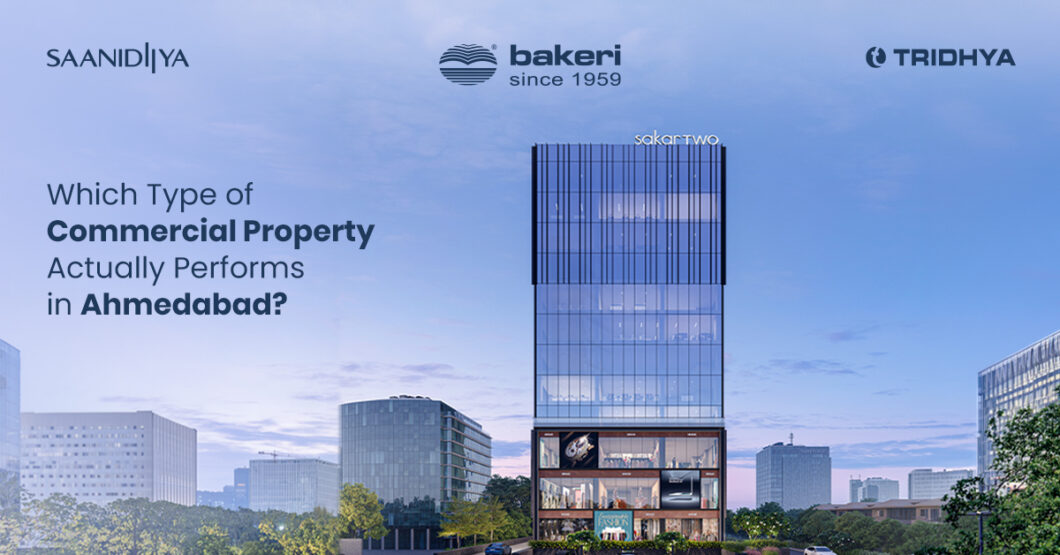
The Ambli–Bopal corridor is a strong example of this dynamic. With one of the highest residential densities in newer Ahmedabad, it supports steady demand for everyday services, dining, and retail. This is evident in locations like Sakar Two at Ambli T Junction, where traffic converges from multiple directions, making footfall structural rather than seasonal.
Retail spaces typically generate around 5 to 7 percent annually, offering more stable but location-dependent returns. Retail works best where daily consumption already exists, as without consistent footfall, even well-positioned spaces struggle to perform.
Mixed-Use Developments: Balanced Returns, Multiple Demand Drivers
The risk with any single-category commercial investment is that its performance depends entirely on one type of demand. Mixed-use developments reduce this by combining components that draw different kinds of people for different reasons, keeping the asset active across multiple use cases.
If one component takes time to lease, another can generate early returns, creating a compounding effect rather than isolated outcomes. In established locations like Navrangpura, this model becomes more effective because demand already exists rather than being projected. This is clearly seen in projects like Three on HL College Road, which benefits from a catchment of students, professionals, and residents, with retail, entertainment, and surrounding activity supporting each other.
Mixed-use developments offer balanced returns, performing strongest in established ecosystems where multiple demand drivers are already active.
What ROI Actually Looks Like in Ahmedabad
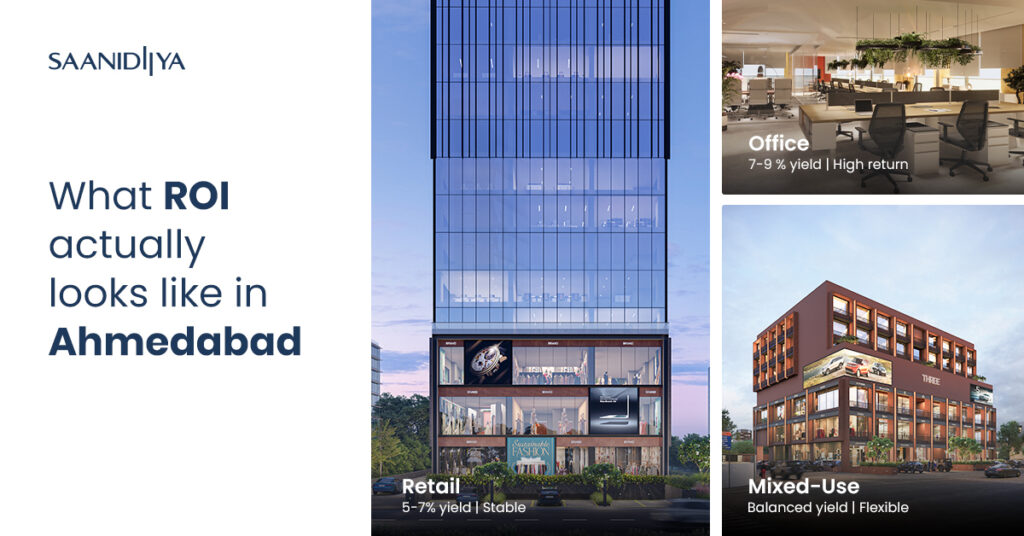
In Ahmedabad, commercial real estate generally delivers stronger rental yields than residential real estate, but returns vary by asset type.To understand how these returns play out across different areas, you can also see where businesses are investing in Ahmedabad in 2026. Office spaces in established business corridors typically generate around 7 to 9 % annually once leased, offering stable income due to longer tenant commitments. Retail can go higher, often reaching 5 to 7% , but this depends heavily on consistency.
Mixed-use developments usually fall somewhere in the middle, depending on how the project balances its components.
What matters more than headline numbers is how the property fits into its surroundings. In growth corridors like Hebatpur and Ambli–Bopal, returns are not purely rental-driven, as increasing residential density and business activity also support capital appreciation over time. For most investors, the real decision is not just where to invest, but which asset type fits their return expectations, as long-term performance depends on how relevant the property remains to businesses and residents around it.
Why Asset Type Matters More Than Location
Many first-time investors start by choosing a location and then looking at available options within it, while more experienced investors take the opposite approach. They first decide on the type of asset that aligns with their income goals, then choose locations that support that asset.
Most investors who struggle with commercial property in Ahmedabad do not choose the wrong location; they choose the wrong asset type for that location.
Knowing how to evaluate a property becomes equally important when deciding the right asset type.
Which Asset Type Fits Your Goal?
| Investment Priority | Asset Type | Where It Works Best |
|---|---|---|
| Stable rental income, lower risk | Office Space | Active or emerging business corridors |
| Higher returns, higher location sensitivity | Retail | Strong residential catchments with existing demand |
| Balance of income and long-term growth | Mixed-Use | Established ecosystems with multiple demand drivers |
At Saanidhya, working across Ahmedabad’s commercial corridors, this difference
is clearly visible. Investors who do well are not the ones chasing the highest returns on paper, but those who align asset type with their investment goals and invest in projects designed for long-term relevance.
Frequently Asked Questions
1. Which commercial property type is easiest to lease in Ahmedabad?
Office spaces are generally easier to lease in established business corridors due to longer tenant commitments. Retail depends heavily on footfall, while mixed-use benefits from multiple demand drivers.
2. Is retail always more profitable than office space?
Not necessarily. Retail can generate higher returns but also carries higher risk. Without consistent footfall, performance can drop. Office spaces offer more stable and predictable income.
3. Are mixed-use developments safer investments?
Mixed-use developments can reduce risk by combining multiple income streams. If one segment underperforms, another can offset the impact. However, success still depends on execution and location strength.
4. What type of commercial property is better for first-time investors?
Office spaces are generally more suitable due to lower vacancy risk and predictable income. Retail and mixed-use require a deeper understanding of location dynamics.
5. How important is developer credibility in commercial real estate?
Developer credibility directly impacts long-term performance. Well-planned projects with strong design and tenant mix are more likely to sustain demand.
6. How long should you hold commercial property for better performance?
Commercial real estate performs best over a medium to long-term horizon. A holding period of 5 to 10 years allows investors to benefit from both rental income and capital appreciation.